
AI Governance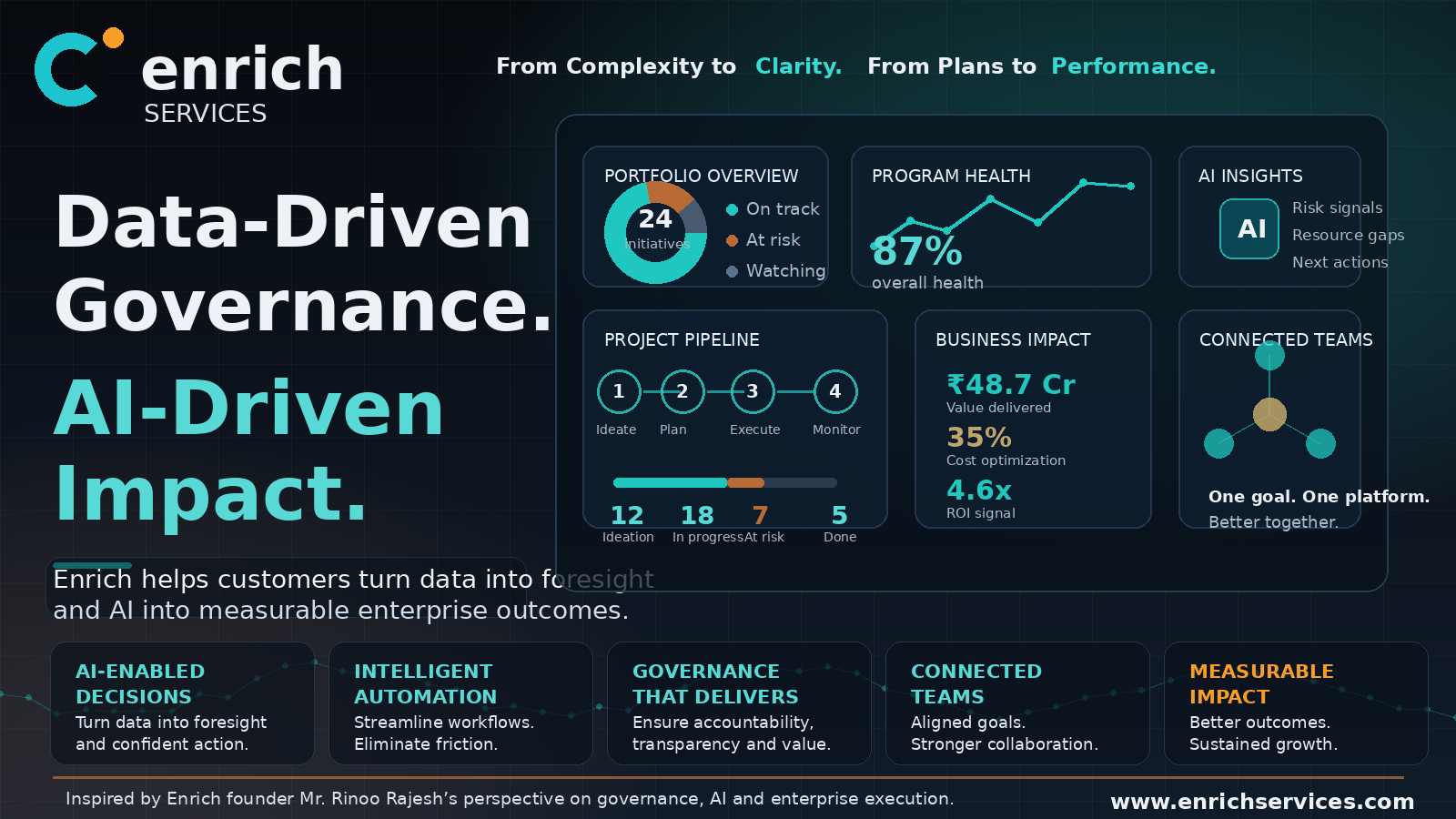
Data-Driven Governance, AI-Driven Impact: From Oversight to Strategic Execution
How Enrich helps enterprises convert data, AI and workflow automation into governance clarity, execution discipline and measurable business outcomes.
How Enrich helps enterprises convert data, AI and workflow automation into governance clarity, execution discipline and measurable business outcomes.
Inspired by perspectives shared by Enrich founder Mr. Rinoo Rajesh on data-driven governance, project execution and AI-led decision support, this article explores how enterprises can move from fragmented oversight to governed, measurable performance.
Modern enterprises are not short of data. They are often short of clarity. Every function has systems, every department has reports, every project has status updates and every leadership review has dashboards, risks, dependencies and action items. Yet many organizations still struggle with one fundamental question: are we truly in control of execution?
This is where data-driven governance becomes a strategic capability. Governance can no longer be limited to periodic reviews, compliance checklists or post-facto reporting. In a fast-moving business environment, governance must help leaders see what is happening, understand what may happen next and intervene before outcomes are compromised.
Many governance models still follow a familiar cycle: teams submit updates, PMOs consolidate reports, leadership reviews status and corrective actions are discussed after delays or escalations have already surfaced. This model becomes fragile when enterprises are managing distributed teams, multiple platforms, digital transformation programs, customer experience priorities, vendor ecosystems and regulatory expectations.
Traditional governance often suffers from fragmented visibility, manual reporting cycles, delayed escalation, disconnected systems and dashboards that show status but not intelligence. The result is predictable: leaders spend too much time asking for updates and too little time shaping outcomes.
Data-driven governance is not merely about creating dashboards. It is about building an execution nervous system for the enterprise. It connects strategy, delivery, operations, performance, risk, accountability and decision-making into one more intelligent operating rhythm.
A mature governance model helps leadership answer practical questions: which programs are off track, which teams are overloaded, which workflows are creating delays, which customer commitments need intervention, which risks are likely to become serious issues and which decisions require leadership attention now.
AI adds a new layer of intelligence to governance. Where traditional dashboards show what has happened, AI-enabled governance can help indicate what is likely to happen. It can identify patterns, detect anomalies, summarize risks, recommend interventions and help leaders focus on the decisions that matter most.
In practical enterprise terms, AI can support predictive risk indicators, automated project health summaries, intelligent prioritization of issues, workflow recommendations, resource and productivity insights, customer intelligence and decision-support dashboards. But AI becomes powerful only when it is embedded into a well-designed operating model with clean data, clear ownership, disciplined workflows and human accountability.
Plans are necessary, but plans alone do not deliver outcomes. Outcomes depend on execution discipline, timely visibility, ownership, collaboration and the ability to respond quickly when reality changes. This is where AI-enabled governance can make a measurable difference.
Imagine an enterprise where leadership can see portfolio health in real time, risks are flagged early, workflow delays are visible before they become escalations, teams know what needs attention and management reviews are supported by intelligent insights rather than static reports. That is the promise of data-driven governance: it turns information into foresight, foresight into action and action into measurable impact.
At Enrich Services, our focus is not technology for its own sake. Our focus is helping organizations achieve measurable business impact through practical, responsible and execution-oriented transformation. We help customers bring together consulting, digital platforms, automation, AI-led insights and governance models to improve how work gets done.
Our work usually begins with the questions that matter most to leadership: how can we get better visibility into performance, reduce manual coordination, improve accountability without adding bureaucracy, apply AI meaningfully to real operational problems and make workflows more intelligent, measurable and outcome-driven?
The accompanying creative captures this idea: portfolio overview, program health, project pipeline, AI insights, business impact and connected teams coming together on one governance canvas. This is the future Enrich believes in — a future where governance does not slow teams down but helps them perform better.
For enterprises, the opportunity is significant. Data-driven governance can improve delivery confidence, customer outcomes, productivity, accountability and strategy-to-execution alignment. But the journey has to be designed carefully, with the right data model, workflows, dashboards, AI use cases, adoption cadence and leadership ownership.
Enrich sees AI-led transformation as a business transformation journey first and a technology journey second. The most successful organizations will not simply deploy more tools. They will redesign how decisions are made, how teams collaborate, how performance is measured and how intelligence flows through the enterprise.
Data-driven governance is a powerful starting point for this shift. It connects strategy with execution, visibility with accountability and AI with measurable business value.
This insight connects directly to Enrich offerings for AI-led transformation, governance visibility and execution performance.